Buying advice / Kitchen & Pantry
Spice Storage Ideas: Drawer Inserts, Tiered Racks, or Wall Shelves?
The best spice organizer is the one that lets you see your everyday jars without creating a new obstacle. Choose the location first, measure the containers second, and buy a rack only if an inexpensive test shows you need one.
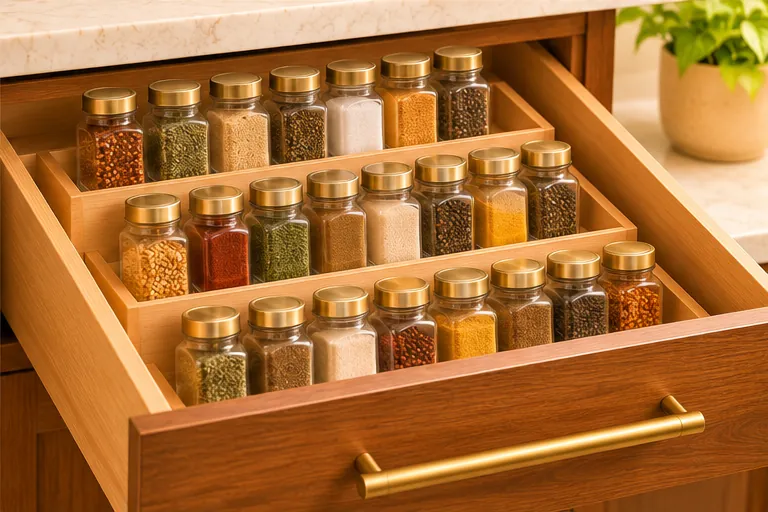
Start with the location, not the rack
Empty one drawer or cabinet shelf and count the spices you reach for in a normal week. If you use six frequently and keep twenty more for occasional recipes, those groups do not need equal-priority space. Put the frequent jars where you can see their labels and reach them without moving another object.
Try a no-purchase layout first: place the jars in a cardboard tray or an empty shoebox and use that arrangement for a few cooking sessions. Does it stay tidy when you are busy? If the improvised tray is already working, consider keeping it instead of ordering new containers.
A drawer works well if the interior is sufficiently tall for the chosen jars and the drawer can close with the organizer installed. A cabinet shelf may be easier for tall bottles. A wall-mounted rack preserves countertop space but adds installation and grease-cleaning considerations.
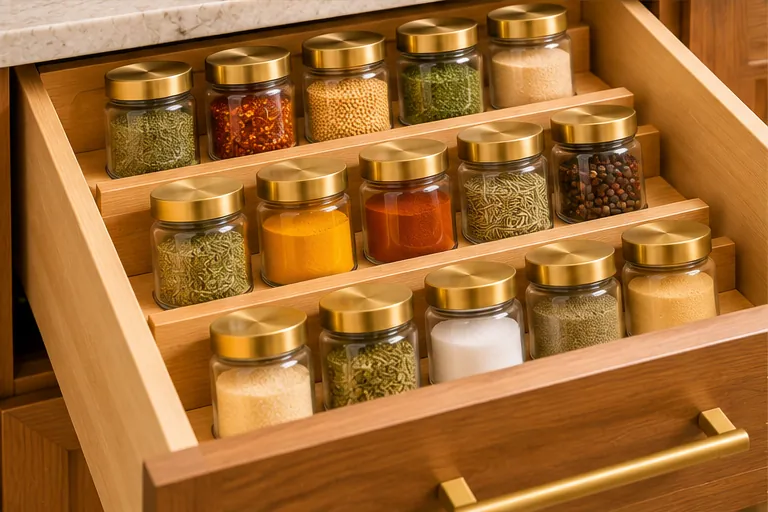
Measure the actual jars and usable opening
Measure the *inside* width, depth, and height of the intended drawer or shelf, including hinges, rails, lips, and any obstruction at the back. Then measure the tallest, widest, and least-standard spice jar you plan to keep. Do not shop based on the outside width of a cabinet front.
For an angled drawer insert, check the height of the highest jar at its intended angle, not just the insert’s advertised height. For tiered risers, verify the height from the top tier to the shelf above; seeing the label is not useful if the jar hits the cabinet. For rotating organizers, check the complete spinning footprint and how far the largest bottle projects beyond the tray.
Example, not a product claim: Suppose a drawer is 17 inches wide, but the organizer is 16.5 inches wide. That leaves just half an inch for imperfect measurements, side hardware, and how the drawer travels. Before buying, use a paper template cut to the organizer’s advertised dimensions to test the fit and access.
Compare three storage approaches
Angled drawer insert: Strong when you have a full-extension drawer and mostly similar jar sizes. The labels can be easy to scan, but mixed jars may roll or sit unevenly, and the insert consumes vertical clearance.
Tiered shelf rack: Strong when your spices live behind a cabinet door and you need to see the back row. It raises the rear jars, so measure the remaining clearance to the next shelf. In a deep cabinet, the farthest row may still be awkward to reach.
Wall or door rack: Strong if a drawer is unavailable. Check door swing, shelf interference, mounting requirements, and weight limits from the actual hardware instructions. Adhesive or over-door mounting is not automatically suitable for every cabinet surface or rental.
Avoid the five expensive mistakes
Do not buy matching jars just to make a shelf look uniform unless you actually want the labor of transferring, labeling, and maintaining them. Original packaging often carries useful product information.
Do not hide the expiration or purchase dates if you decant spices. Do not store containers where heat, moisture, or cooking splashes are frequent.
Do not buy an organizer from a pretty picture without checking jar count and mixed-bottle compatibility. A listing’s stated capacity is not necessarily the number of *your* jars it can hold.
Do not place an everyday rack where a person must stand on a step stool or move heavy items to reach it. If somebody cooks while seated or has reduced grip strength, prioritize an easy reach.
Finally, do not assume that a wall-mounted rack will fit a door or stud layout without checking the manufacturer’s mounting directions.
Choose what is right for your kitchen
Choose the drawer insert when access and label visibility outweigh storage density. Choose a tiered riser when cabinets are your only practical space and the remaining vertical clearance is generous. Choose wall storage only when the installation is safe and it improves the workflow.
If your current arrangement works, skip the purchase. If it fails because the jars are hard to identify, try better labeling before replacing the rack. If it fails because you cannot reach the back row, try a shallow tray or a pull-forward bin before committing to a new system.
Before ordering, record the interior dimensions in My Room Project and use the shelf-fit calculator. Our Before You Buy checklist covers delivery, returns, and missing specifications.
Products to compare
As an Amazon Associate I earn from qualifying purchases. These are related options from our buyer-guide research, not hands-on tested rankings. Check current listing details, fit and availability before ordering.
- Spice Rack Kitchen Cabinet Organizer- 3 Tier Bamboo Expandable Display Shelf Yellow — A three-tier expandable bamboo display shelf raises rear jar rows and adapts to the width of a cabinet. View on Amazon (paid link).
- SpaceAid Bamboo Spice Drawer Organizer, (Need 3" Deep Drawer) Expandable 4 Tier Spices Rack for Cabinet,… — SpaceAid's expandable four-tier bamboo drawer rack calls for a three-inch-deep drawer; check jar height as well. View on Amazon (paid link).
- AISIPRIN Glass Spice Jars with 398 Labels, 24 pcs 4oz Spice Containers with Bamboo Lids, Square Spice Bottles… — AISIPRIN's 24 square four-ounce glass jars include bamboo lids and 398 labels for creating a consistent spice collection. View on Amazon (paid link).
See the complete buyer guide for more options and fit checks.
Frequently asked questions
Practical answers about spice storage ideas, fit and everyday use.
Should spices be stored in a drawer or near the stove?
Choose an accessible location away from excessive heat, moisture and direct light. Check jar height and drawer clearance before buying a rack.
Is spice drawer organization better than a rack?
A drawer insert keeps labels visible from above and frees counter space; a rack suits people without a spare drawer near the stove. Measure jar height and drawer depth first.
How do I approach spice rack organization?
Sort by how often you cook with each spice, keep daily spices nearest the stove, and label lids if jars are stored lying down or viewed from above.
What should I measure before buying a spice rack?
Measure the usable interior width, depth, and vertical clearance; check obstructions and the dimensions of your biggest jars. An outside cabinet measurement is not enough.
Is a drawer insert better than a shelf riser?
A drawer insert helps with quick label scanning if the jars and drawer height fit. A shelf riser helps in a cabinet when there is enough space above its highest tier.
Should I transfer spices into matching jars?
Only if the benefit is worth the extra work. Keeping original containers can be simpler and preserves their labels and product information.
Can a spice rack go beside the stove?
Only if its location stays away from heat, steam and splatter. Frequently used spices belong within easy reach, but a cooler cabinet or drawer often protects flavor better.
What is a good spice drawer layout for refill packets?
Reserve one labeled section for opened containers and another for sealed refills; check drawer height before committing to angled inserts.
Further reading and source notes
These public references informed general storage and safety guidance. We did not independently lab-test or review retail products.
This is independent educational guidance, not a hands-on product review. Brand, model, safety, and price claims must be checked against a real listing before purchase. Editorial and affiliate disclosure.